Prototype Archetypes
April. 5. 2026
If you work in physical product development, you already understand how critical prototyping can be in bringing ideas to life. What is often under-appreciated is why building ideas is one of the most powerful tools for driving alignment, accelerating decisions, and de-risking investment. It’s not just validating a concept’s overall form and function.
The right prototype, at the right moment, creates clarity well beyond any slide deck, render, or CAD model. It builds shared understanding across disciplines, unlocks momentum with stakeholders, and provides a practical way to assess the potential of a concept, the scope of future needs, and the energy required to move forward.
“When prototyping is approached strategically, it can become one of the most powerful levers in physical product development.”The four archetypes
We treat prototyping not as a linear end phase but as a continuous decision-making engine. Prototyping is the strategy for both discovery and validation, and we get the added benefit of a functional, physical example.
But that doesn’t mean we just prototype as our only or first default. Prototypes should be designed to answer specific questions. Their level of fidelity needs to align with what we are trying to learn during a given development phase.
Without this discipline, prototyping can easily become expensive theater. With it, prototyping becomes one of the highest ROI activities in a development program.
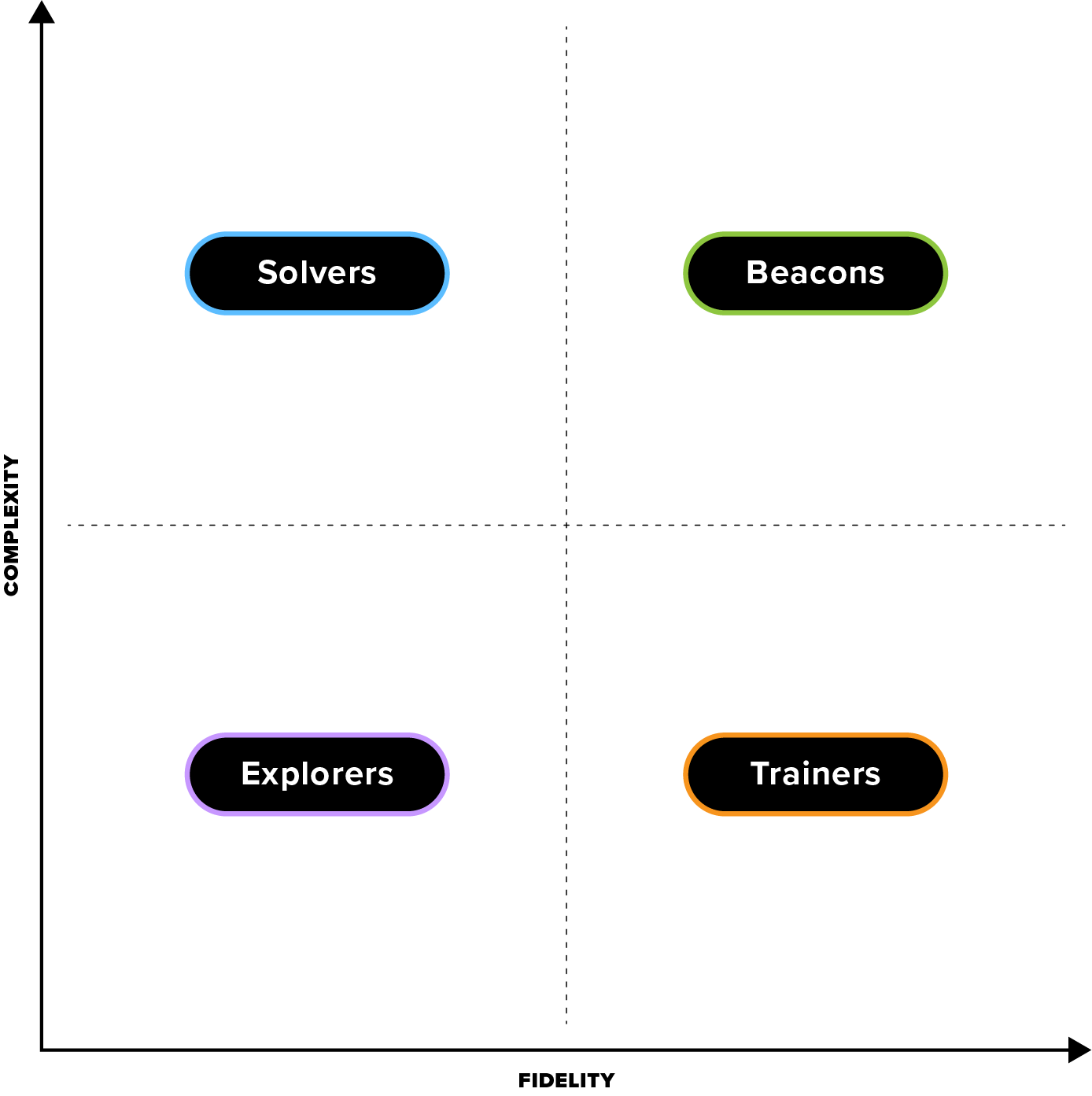
Our team uses a 2×2 framework that identifies four prototype archetypes commonly encountered across product development programs. This framework helps teams stay aligned on stage goals, manage expectations, and focus effort where it creates the most leverage.
Explorers
Low fidelity · Low complexity -Explorers are our most frequently built and used prototypes because they deliver the highest creativity-per-hour. These builds live squarely in the divergent phase of development and are focused on discovery rather than presentation.
Often created before refined sketches or CAD, Explorers come to life immediately after foundational research. They may include rough 3D prints, cardstock form studies, material adhesion tests, or rapid spatial mockups. The goal is to learn as quickly as possible and evaluate how form, materials, and assembly might work.
Explorers are intentionally small and often in coupon form. Their value lies in generating insight, not in polish. We move quickly, build many, and stop once we reach learning plateaus. These are rarely client-facing, but they quietly inform every strong decision that follows.
Value: creative discovery, directional clarity, early risk reduction
Pitfalls: not doing enough of them

Solvers
Low fidelity · High complexity - Solvers emerge once viable solution pathways begin to converge. These prototypes focus on resolving specific technical or integration challenges and proving that a direction is feasible.
This archetype often becomes the most client-visible early in a program. Solvers demonstrate possibility, like how a mechanism works, how materials interact, or how a system integrates across disciplines. They require a clear target and careful scoping, as build time and complexity can quickly increase.
Common failure modes include moving into Solvers too early (without sufficient Explorers) or selecting materials that distort the learning objective.
Value: feasibility validation, stakeholder confidence, assessing technical risk
Pitfall: unclear targets or premature convergence
Trainers
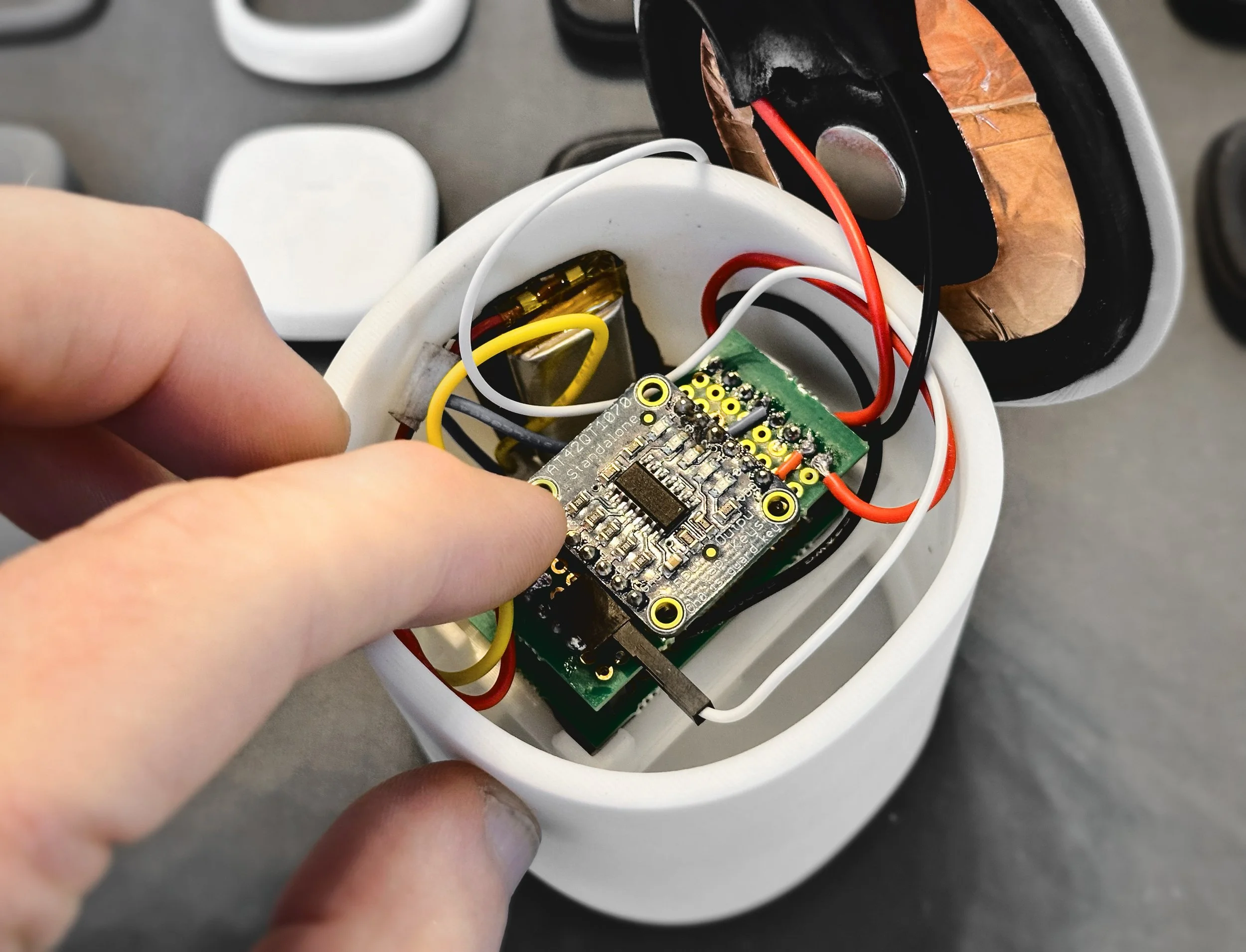
High fidelity · Low complexity - Trainers are high detail builds applied to relatively simple ideas. They are most often used when production partners require hands-on guidance or when aesthetic fidelity is needed without full functionality.
This category includes appearance models and built-to-teach prototypes. While useful in specific circumstances, Trainers can consume disproportionate time without generating much new insight if misapplied. With capable manufacturing partners, detailed CAD, specifications, and lower fidelity builds are often sufficient.
Value: production alignment, aesthetic communication
Pitfalls: over-investing without advancing learning

Beacons
High fidelity · High complexity - Beacons represent the convergence point of a disciplined development process. These are the most detailed, time-intensive prototypes and often serve as executive-level demonstrations, investor or crowdfunding assets, and production look-alike examples.
While still prototypes with known concessions in durability, strength, or finish, Beacons provide unmatched clarity for stakeholders who struggle to extrapolate from screens alone. They tend to generate the strongest emotional and strategic buy-in. For projects with startups, our Beacon builds have been prototypes used on Shark Tank, demos in Kickstarter campaigns, or the concept example on a client’s website when they come out of a stealth phase.
Because of their cost and effort, Beacons are only effective when built on the insights of Explorers and Solvers. When done well, they compress timelines and accelerate downstream decisions.
Value: alignment at highest levels, funding enablement, launch momentum
Pitfalls: skipping prerequisite learning stages

How we use this framework.
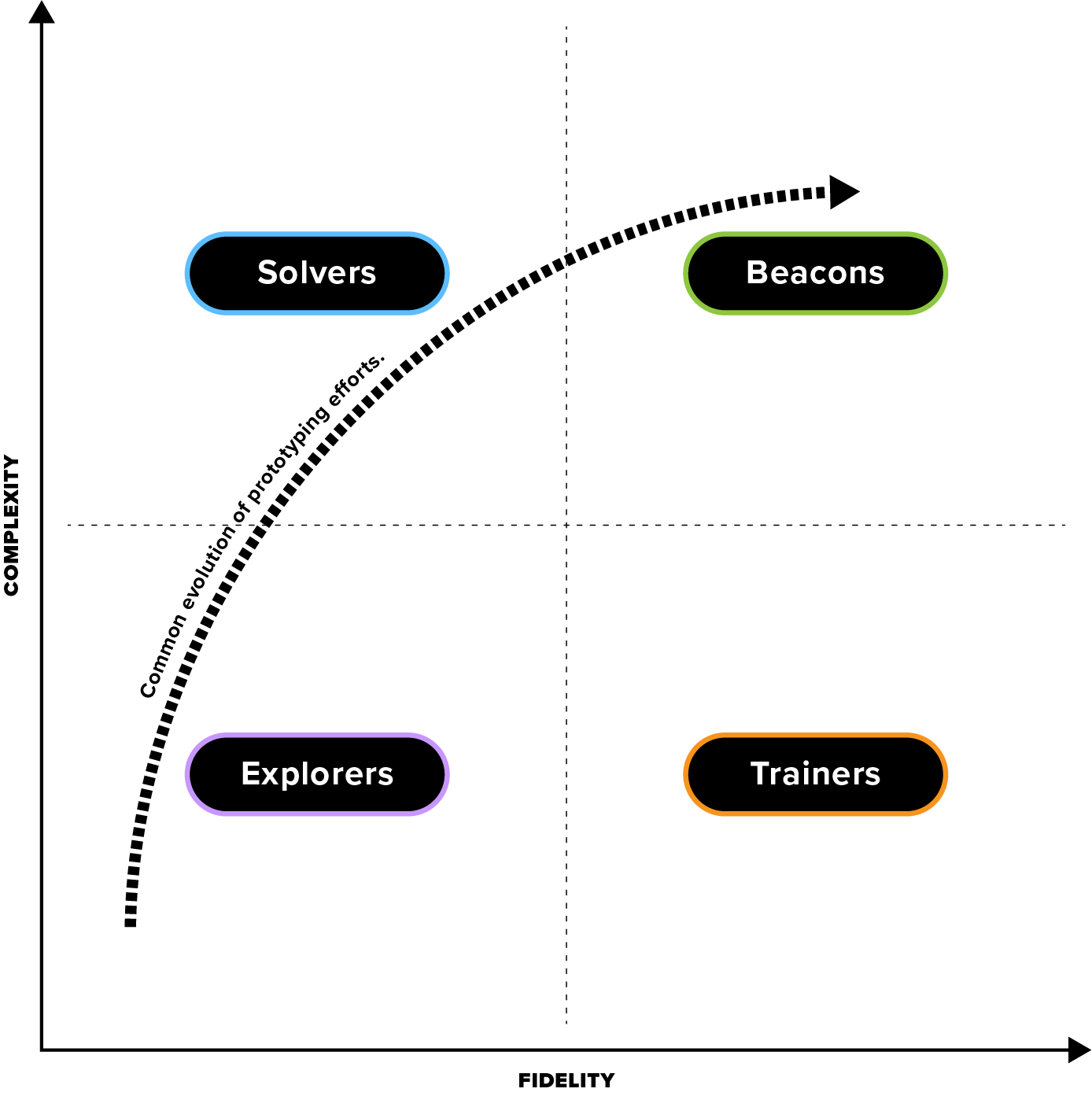
Most of our development programs use two or three of these archetypes. Occasionally, a complex initiative will benefit from all four. When prototyping is used as a decision engine, we often see a natural progression from Explorers to Solvers, and finally to Beacons. And the progression builds in an arc of successive archetypes.
What matters most is aligned expectations and intentionality in what we are aiming to achieve. The build efforts can then be focused on meaningful results that can advance the program.
This prototyping framework allows our team and clients to:
· set clear expectations around time and investment
· align teams on what a prototype is meant to achieve
· avoid costly over-building
· use prototyping as a tool for decisions
When prototyping is approached strategically, it can become one of the most powerful levers in physical product development. Each project is unique, be we typically find ourselves moving along a consistent development path.


Explore More Insights