The Lightbulb Myth
July. 7. 2026
Our culture loves the story of a breakthrough moment. Someone, like an inventor, has a flash of inspiration. Or a founder suddenly sees an opportunity no one else recognizes. Or in our case, an engineer or designer sketches the perfect solution on the back of a napkin. The lightbulb turns on, everything becomes clear, and the rest is simply execution.
We understand why this is an appealing narrative: it compresses complexity into a single moment. It’s a great story to have a breakthrough to arrive fully formed, taking uncertainty directly into clarity. And spoiler alert, product development rarely works that way. While every project contains moments of insight, they seldom coalesce into a single defining revelation. Instead they often emerge as a sequence of discoveries that gradually illuminate the path forward.
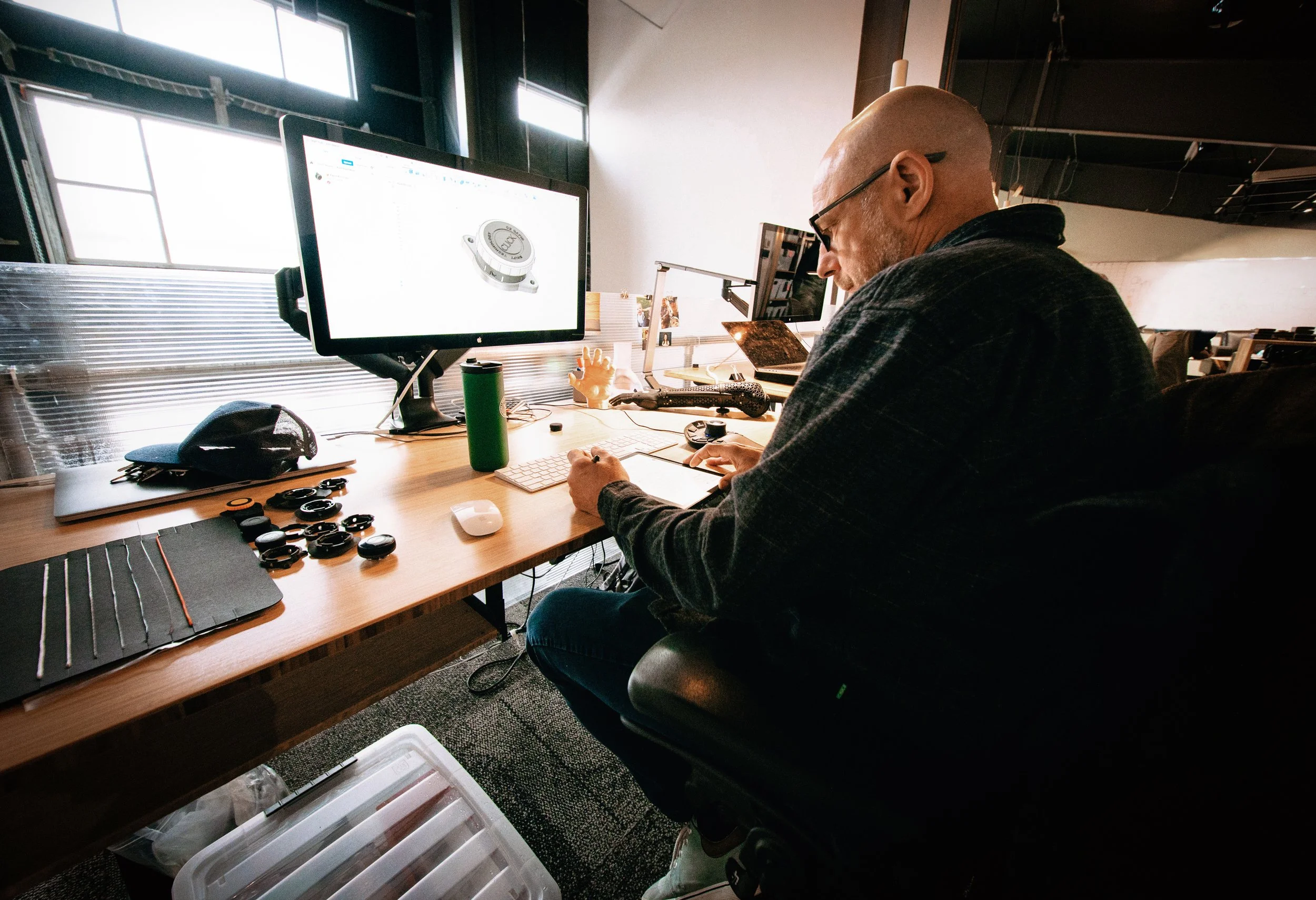
The value of a great idea is rarely found in the initial spark alone.The design process is not a single lightbulb, but more a long strand of them. Some shine brightly and can immediately alter a project’s direction. Others are smaller, providing a subtle clue about what may come next. Occasionally, an idea flickers briefly before proving unhelpful, while another may send the team down a path that ultimately reveals an even better opportunity. Each contributes to a broader understanding of the problem, and the cumulative effect of these moments eventually creates clarity on the ultimate solution.
This is exactly why we emphasize prototyping, collaboration, and rapid iteration in our process, as they increase the likelihood of these types of discoveries. Useful insights can emerge from places we could not have predicted at the beginning of a project. Rough prototypes may reveal an unexpected user behavior or annoyance we didn’t see coming. Material experiments may uncover an opportunity that was invisible in CAD. Even a simple question from a teammate can reframe a challenge in a way that changes how we think about the solutions available.
It’s perhaps odd to state at the dawn of AI, but this is why we believe there are very few shortcuts in the creative aspects of product development. The value of a great idea is rarely found in the initial spark alone. It emerges through the disciplined process of refining, testing, and improving that idea over time. Every round of prototyping reveals new information. Each interaction exposes another layer of understanding. Further down the pipeline, engineering reviews, supplier discussions, and manufacturing constraints contribute other key pieces of the puzzle. What starts as a promising concept gradually evolves into something more complete and resilient as it is shaped by diverse perspectives and cycles of learning.
Charles Eames famously said "the details are not the details; they make the design." We have found this to be incredibly true. The most successful products are rarely defined by a single feature detail or a single process detail. They are defined by network of details and dozens (sometimes hundreds) of smaller decisions that collectively improve functionality, manufacturability, usability, aesthetics, and value. An initial idea may help establish direction, but it is the accumulation of refinements that determines whether a product ultimately succeeds.

Perhaps most important, these insights rarely belong to a single person. Product development is inherently collaborative. Researchers, designers, engineers, technicians, suppliers, manufacturers, marketers, and stakeholders all contribute observations that influence the final outcome. An engineering constraint may inspire a better user experience. A manufacturing challenge may lead to a simpler architecture. A customer observation may reveal an entirely new opportunity. Each insight builds upon the others, creating a result that is often greater than the sum of its individual parts.
In many ways, innovation looks less like a lone inventor standing beneath a newly illuminated lightbulb and more like a team thoughtfully wiring an entire string of them together. Each insight adds a little more visibility, while experiments reveal the next steps on the path ahead. And while some bulbs shine brighter than others, it is the collective illumination that ultimately guides a project from an idea into a successful product.


Explore More Insights